Understanding Salivary Gland & Duct Stones

Salivary gland and duct stones are relatively common conditions that can lead to significant discomfort and complications if not addressed. Understanding the causes, symptoms, and available treatment options is essential for effective management. With timely intervention, most individuals can achieve complete relief from symptoms and restore normal function to the affected salivary gland.
What are Salivary Gland Stones?
Salivary gland stones, medically known as sialolithiasis, occur when mineral salts (calcium, phosphate, magnesium) accumulate and form calcified masses within the salivary glands or their connecting ducts. They can vary in size and measure up to 1.5cm in diameter. This results in the blockage of saliva flow, causing pain, swelling, and sometimes infection of the affected gland.
Salivary gland stones, while rare, are the most common inflammatory salivary gland disease. It can affect any of the three major salivary glands found in the human body.
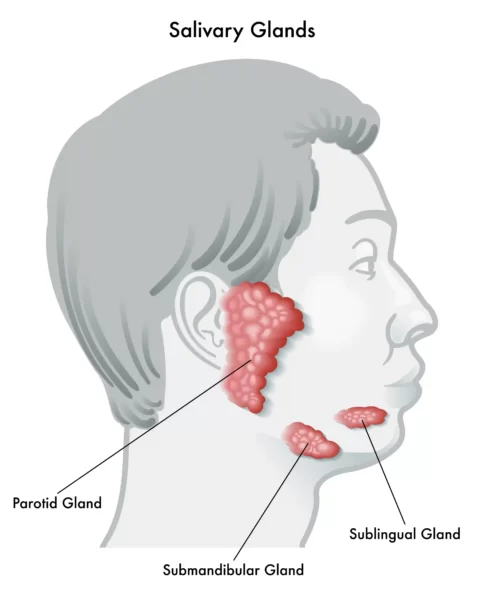
- Parotid Salivary Gland Stone: These stones are found in the glands located on either side of the face, in front of the ears. They are the largest of the salivary glands.
- Sublingual Salivary Gland Stone: These stones are found in the glands located under the floor of the mouth.
- Submandibular Salivary Gland Stone: These stones are found in the glands located under the jaw. These glands produce the majority of the saliva in the mouth.
According to Cleveland Clinic, 80% of salivary gland stones are found in the submandibular gland due to two main factors:
- Location: Positioned under the jaw, saliva from the submandibular gland has to flow upwards via its connecting duct (Wharton’s duct) against gravity. This causes saliva to travel less effectively and hence can develop into stones more often.
- Saliva Content: Saliva flowing in through the Wharton’s duct tends to be thicker and have higher calcium content, making it easier for stones to develop.
Stones can also develop in the parotid glands near the ears and, less frequently, in the sublingual glands under the tongue.
Symptoms of Salivary Gland Stones
The symptoms of salivary gland and duct stones can vary depending on the size and location of the stone. As such, symptoms may occur on one side (unilateral) or, more uncommonly, on both sides (bilateral).
Common symptoms of salivary gland stones include:
- Pain and swelling, especially in the affected gland, can be felt as facial pain.
- Dry mouth due to reduced saliva flow.
- Difficulty swallowing or opening the mouth in severe cases.
- Infection (sialadenitis) and bacterial growth can occur if saliva flow is blocked. Signs of an infection include:
- Pus discharge
- Bad or strange taste in the mouth
- Fever
Are Salivary Gland Stones Always Painful?
Whether salivary gland stones cause pain depends on the size and location of the stone.
- When stones are large enough, they may completely block salivary ducts, which causes pain. Symptoms of salivary gland stones usually worsen as you eat due to increased saliva production that will be blocked by the stone. These symptoms may be intense during meals but will subside after a few hours. This condition may be intermittent or persistent for over a few weeks.
- Most of the time, patients with smaller stones may not develop any symptoms, feel no pain, or experience occasional dull pain.
Symptoms of salivary gland stones may frequently overlap with other head and neck conditions, like salivary gland lumps (benign or cancerous growths in the glands). As such, visiting an ENT head and neck specialist for a proper diagnosis is important to address the root cause of your symptoms.
Causes of Salivary Gland Stones
The exact cause of salivary gland stones is not entirely understood, but conditions contributing to the thickening of saliva can contribute to their formation.
Who is More Prone to Developing Salivary Gland Stones?
Risk factors contributing to the formation of salivary gland stones include:
- Dehydration: Insufficient fluid intake reduces saliva production, increasing the risk of stone formation.
- Diet: A diet high in calcium and low in hydration may contribute to stone development.
- Reduced Saliva Flow: Conditions (e.g., gout) or medications (e.g., diuretics, antidepressants, etc) that decrease saliva production can increase the risk.
- Smoking: This habit can decrease saliva flow and cause inflammation of the salivary glands and ducts, resulting in stone formation.
- Physical Trauma: Injury to the salivary glands or ducts may lead to stone formation.
How does an ENT Head and Neck Surgeon in Singapore Diagnose Salivary Gland Stones?
Diagnosing salivary gland stones involves a combination of clinical examination and imaging tests:
- Physical Examination: An ENT specialist may palpate the area to locate the salivary gland stone under the tongue or other surrounding areas and assess swelling or tenderness. This is done by placing a gloved finger inside the mouth and having the other fingers outside the mouth to feel for a lump.
- Ultrasound: This is a common non-invasive imaging test that can visualise stones within the glands or ducts.
- Sialography (sialogram): This is a form of X-ray test that involves injecting a dye into the salivary ducts before images are taken. This technique can provide visuals of abnormalities but is less commonly used due to the risk of exacerbating symptoms.
- CT Scan: Provides detailed images of the salivary glands and ducts, helpful in complex cases.
What are the Treatment Options Available for Salivary Gland Stones?
Treatment options for salivary gland stones may vary depending on the patient’s condition. The severity of a salivary gland stone can be determined by their size:
- Small: 4 millimeters or smaller
- Medium: 5-6 millimeters
- Large: 6 millimeters or larger
Several options are available with the aim of removing the stone and restoring saliva flow:
- Hydration and Massage: Drinking plenty of water and massaging the affected gland can sometimes help small stones pass naturally. Applying heat like a warm compress may also help with the discomfort.
- Sialogogues: Substances that stimulate saliva production, like sour candies or lemon juice, can increase saliva flow and help dislodge the stone.
- Manual Sialolithiasis Removal: An ENT head and neck surgeon may attempt to remove the stone manually if it is located near the duct’s opening.
- Lithotripsy: A non-invasive procedure that uses shock waves to break the stone into smaller pieces that can pass more easily.
- Surgery: In cases where the stone is too large or inaccessible, using less invasive methods, surgical removal may be necessary. In rare cases, patients with recurrent or untreatable sialolithiasis stones may be recommended a gland removal procedure.
Patients opting for at-home remedies or conservative treatment may achieve temporary relief. However, for those looking for effective solution, they can typically be achieved through surgery. If patients have developed an infection, they will require antibiotics as part of their treatment and if left untreated, infected sialolithiasis can spread to other parts of the neck.
Patients should never attempt to manually remove or force salivary gland stones on their own as they may cause further damage, scarring or risk an infection.
There are several preventive measures that one can consider to avoid the onset or recurrence of salivary gland stone formation. These include habits that involve lifestyle changes aimed at maintaining healthy saliva flow:
- Stay Hydrated: Drinking plenty of water throughout the day helps ensure adequate saliva production.
- Good Oral Hygiene: Regular brushing, flossing, and dental check-ups can reduce the risk of infections that might contribute to stone formation.
- Quit Smoking: Tobacco use can decrease saliva flow and contribute to stone formation.
- Dietary Considerations: While no direct link between diet and sialolithiasis has been established, a balanced diet with adequate hydration is recommended.
When should you see an ENT Head & Neck Surgeon in Singapore for Salivary Gland Stones?
If you suspect you have a salivary gland stone, it’s essential to consult an ENT head and neck specialist for an accurate assessment and tailored treatment plan. In Singapore, book an appointment with Dr Ker Liang, a seasoned ENT Head and Neck Surgeon at Aglow ENT Centre. With experience handling ear, nose, throat, head and neck conditions, Dr Ker Liang is well-equipped to provide an accurate diagnosis and perform procedures to remove salivary gland stones. The clinic is located at the heart of Orchard, where patients can easily access the clinic and achieve relief from their symptoms.
Frequently Asked Questions
Can salivary gland stones cause ear pain?
Salivary gland stones can sometimes cause ear pain, especially when the parotid gland is affected.
How do you massage out a salivary gland stone?
You can massage the stone along the direction of the duct towards the opening of the mouth.
Are antibiotics sufficient enough to treat salivary gland stones?
Antibiotics are only used to help treat infections from salivary gland stones.
Can salivary gland stones go away on their own?
Small salivary gland stones can go away on their own, especially with lifestyle changes as recommended by medical professionals.
Are tongue ulcers and salivary gland stones the same?
No, they are not the same conditions.
Is sialolithiasis contagious?
No, salivary stones themselves are not contagious. However, bacteria from infected salivary glands can be contagious.
Medical Teaching
Assistant Professor Ker Liang has a passion for teaching and is an Assistant Professor with NUS Yong Loo Lin School of Medicine (YLLSOM). As the NUS-NUH Otolaryngology Department Undergraduate Medical Director, Dr Ker Liang supervises the training of medical students from YLLSOM, NUS. She is actively involved
in the training of postgraduate junior doctors and residents in the Head and Neck Surgery department. She was conferred with an Undergraduate Teaching Award by the National University Health System in 2016 for her outstanding efforts as an Otolaryngology educator.
Medical Teaching
Assistant Professor Ker Liang has a passion for teaching and is an Assistant Professor with NUS Yong Loo Lin School of Medicine (YLLSOM). As the NUS-NUH Otolaryngology Department Undergraduate Medical Director, Dr Ker Liang supervises the training of medical students from YLLSOM, NUS. She is actively involved
in the training of postgraduate junior doctors and residents in the Head and Neck Surgery department. She was conferred with an Undergraduate Teaching Award by the National University Health System in 2016 for her outstanding efforts as an Otolaryngology educator.
Lorem ipsum dolor sit amet, consectetur adipiscing
Lorem ipsum dolor sit amet, consectetur adipiscing elit. Ut elit tellus, luctus nec ullamcorper mattis, pulvinar dapibus leo. Lorem ipsum dolor sit amet, consectetur adipiscing elit. Ut elit tellus, luctus nec ullamcorper mattis, pulvinar dapibus leo.
Lorem ipsum dolor sit amet, consectetur adipiscing
Lorem ipsum dolor sit amet, consectetur adipiscing elit. Ut elit tellus, luctus nec ullamcorper mattis, pulvinar dapibus leo. Lorem ipsum dolor sit amet, consectetur adipiscing elit. Ut elit tellus, luctus nec ullamcorper mattis, pulvinar dapibus leo.
Lorem ipsum dolor sit amet, consectetur adipiscing
Lorem ipsum dolor sit amet, consectetur adipiscing elit. Ut elit tellus, luctus nec ullamcorper mattis, pulvinar dapibus leo. Lorem ipsum dolor sit amet, consectetur adipiscing elit. Ut elit tellus, luctus nec ullamcorper mattis, pulvinar dapibus leo.
Lorem ipsum dolor sit amet, consectetur adipiscing
Lorem ipsum dolor sit amet, consectetur adipiscing elit. Ut elit tellus, luctus nec ullamcorper mattis, pulvinar dapibus leo. Lorem ipsum dolor sit amet, consectetur adipiscing elit. Ut elit tellus, luctus nec ullamcorper mattis, pulvinar dapibus leo.
Lorem ipsum dolor sit amet, consectetur adipiscing
Lorem ipsum dolor sit amet, consectetur adipiscing elit. Ut elit tellus, luctus nec ullamcorper mattis, pulvinar dapibus leo. Lorem ipsum dolor sit amet, consectetur adipiscing elit. Ut elit tellus, luctus nec ullamcorper mattis, pulvinar dapibus leo.